

Table of Contents
- Best Pool Cue for League Play: Quick Comparison
- 1. Pure X HXT66: Best Overall Value for League Players
- 2. Cuetec Cynergy Truewood Leopard I: Best Premium Carbon Fiber Pick
- 3. Cuetec Cynergy Truewood Ebony I: Classic Looks, Modern Shaft
- 4. Cuetec Cynergy X Raw: Best No-Wood-Core Shaft
- 5. Viking Cues Helix HL0116: Best No-Wrap Grip Under $400
- 6. Viking Valhalla VA471: Best Budget Cue with a Lifetime Warranty
- 7. Dufferin Curly Maple Blue Recon: Best Leather-Wrap Cue Under $200
- How to Choose a Pool Cue Weight for League Play
- Carbon Fiber vs Wood Pool Cue Shafts: What League Players Should Know
- Pool Cue Maintenance Tips for League Players
- Frequently Asked Questions
Last Updated: October 9, 2026
Best Pool Cue for League Play: Quick Comparison
Finding the best pool cue for league play means matching shaft technology, weight, and grip to how you shoot under pressure. At sibilliards, we stock the brands league players ask for by name; this guide covers eight cues we would put in a competitive player's case.
League night punishes inconsistency: a cue that deflects unpredictably on off-center hits costs you position, and position wins racks. These eight cues span about $160 to just under $1,400, each solving a different problem, deflection, grip feel, weight tuning, or durability.
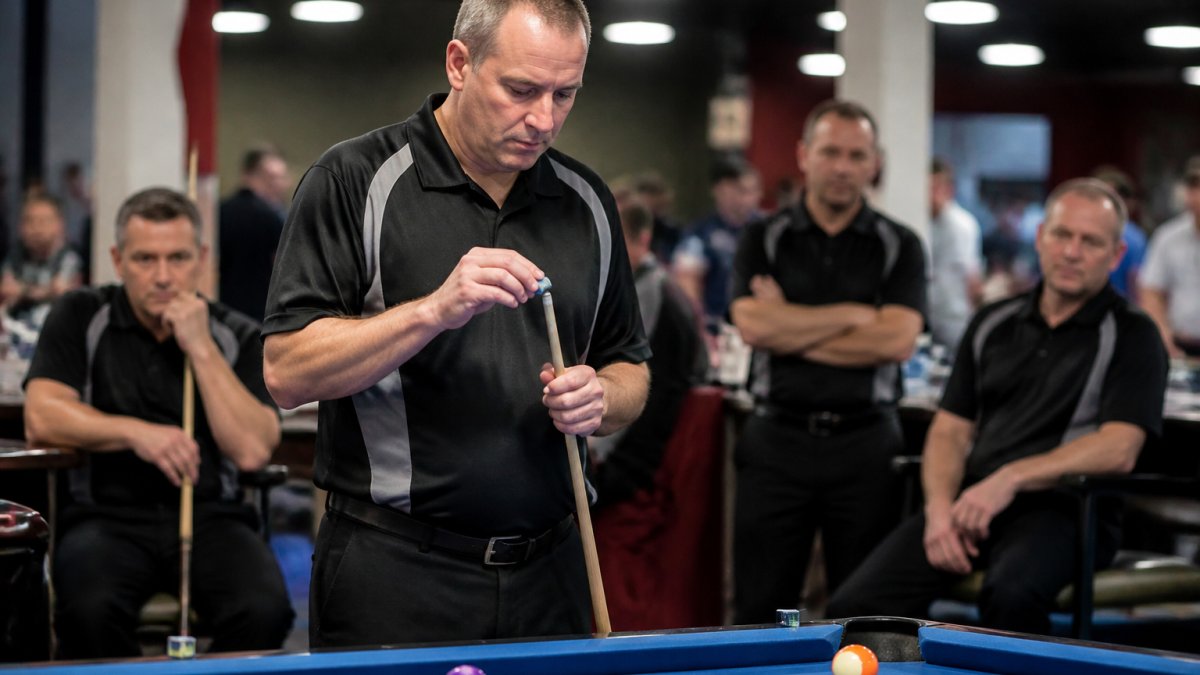
How We Evaluated These League Cues
We judged every cue on deflection control, weight adjustability, joint and tip quality, and warranty.
Deflection is the biggest differentiator: strike off-center and the shaft flexes, sending the ball off your aim line. Low-deflection shafts reduce that error, critical in league play, where every miss hands your opponent the table.
Weight adjustability came second. League players often shoot best between 18 and 19 ounces, but the right number is personal, and adjustable systems let you fine-tune without buying a new cue.
Joint and tip quality rounded out the scoring: a tight joint pin and quality laminated tip mean consistent hit feel.
Cue |
Price |
Shaft |
Weight System |
Best For |
|---|---|---|---|---|
$395.10 |
HXT low deflection, 12.75mm |
Fixed |
Best overall value |
|
Cuetec Cynergy Truewood Leopard I |
$975.00 |
Cynergy carbon, 12.5mm |
Acueweight Gen II |
Premium carbon fiber |
Cuetec Cynergy Truewood Ebony I |
$899.00 |
Cynergy carbon, 12.5mm |
Acueweight Gen II |
Classic looks, modern shaft |
Cuetec Cynergy X Raw |
$1,389.00 |
Cynergy carbon, 12.5mm, no wood core |
Acueweight Gen II |
Lowest deflection |
Viking Helix HL0116 |
$387.00 |
Vikore performance |
Fixed |
No-wrap grip under $400 |
Viking Valhalla VA471 |
$202.50 |
Standard maple |
Fixed |
Budget with lifetime warranty |
Dufferin Curly Maple Blue Recon |
$194.00 |
Professional taper |
Fixed |
Leather wrap under $200 |
1. Pure X HXT66: Best Overall Value for League Players
Our top pick for most league players is the Pure X HXT66, pairing a genuine low-deflection shaft with a Kamui Black Soft tip at a price that undercuts most carbon fiber options by hundreds of dollars.

The HXT shaft uses a lightweight polymer core in the ferrule, where most deflection reduction happens.
The MZ Multi-Zone Grip is back-end loaded, keeping your grip hand from sliding forward during a firm stroke. The 5/16 x 18 joint is the most common pin, so replacement shafts are easy to find.
The one limitation: weight is fixed. If you need 18 ounces instead of 19, this cue will not adjust, a non-issue for players who know their preferred weight.
Where to get it: Pure X HXT66 Pool Cue Stick, Kamui Tip, Low Deflection, Lifetime Warranty
2. Cuetec Cynergy Truewood Leopard I: Best Premium Carbon Fiber Pick
The Cuetec Cynergy Truewood Leopard I is the premium carbon fiber pick for league players who want maximum consistency and will pay for it.

Carbon fiber shafts are the professional standard: the material does not warp, resists dings better than maple, and delivers the same hit feel year after year.
The Leopard I uses a no-wrap handle, if you have had a linen wrap go slick in a humid pool hall, you understand why some players refuse to go back.
The tradeoff is price: roughly double the HXT66 for a shaft material upgrade. Whether that is worth it depends on how seriously you take league play.
Where to get it: Cuetec Cynergy Truewood Leopard I Pool Cue with 12.5mm Carbon Shaft No Wrap
3. Cuetec Cynergy Truewood Ebony I: Classic Looks, Modern Shaft
Players who want carbon fiber performance in a traditional-looking cue should look at the Cuetec Cynergy Truewood Ebony I.

That matters more than it sounds.
Specs are nearly identical to the Leopard I: 3/8 x 14 Cuetec joint, 19-ounce standard weight adjustable in 0.25-ounce increments, Tiger Sniper laminated soft tip, and a Duo Extension-ready bumper.
At $899, it undercuts the Leopard I by about $76 with the same shaft technology. If looks matter less than the shaft, either cue performs the same.
Where to get it: Cuetec Cynergy Truewood Ebony I Pool Cue with 12.5mm Carbon Shaft No Wrap
4. Cuetec Cynergy X Raw: Best No-Wood-Core Shaft
The Cuetec Cynergy X Raw is the lowest-deflection cue in this guide at $1,389, for league players who have maxed out their stroke mechanics and want the last few percent of consistency.
The key difference is shaft construction. Most carbon fiber cues, including the Truewood models above, wrap carbon around a wood core; the Cynergy X Raw uses a multi-layer carbon fiber composite with no wood core at all.
The Triplex carbon fiber and alloy Matrix butt cap and joint collar add stiffness at the joint, reducing energy loss on firm shots. Standard weight is 19 ounces, adjustable in 0.25-ounce increments via the Acueweight Generation II system.
The honest limitation: this is a lot of cue for a casual league player.
Where to get it: Cuetec Cynergy X Raw No Wrap with 12.5mm Shaft
Pure X HXT66 Pool Cue Stick, Kamui Tip, Low Deflection, Lifetime Warranty →
5. Viking Cues Helix HL0116: Best No-Wrap Grip Under $400
If you want a no-wrap handle without crossing $400, look at the Viking Cues Helix HL0116. At $387, it delivers Viking's Vikore Performance Shaft and a smooth, uninterrupted grip.
Vikore shafts are built for consistent, controlled shots rather than maximum spin, with a hit feel a bit firmer than the Pure X HXT, some players prefer it for straight-in shots.
Viking has built cues for decades, and the Helix line is their performance-focused mid-tier.
The limitation: no adjustable weight system. If you are between weights, plan to add or remove a weight bolt, or choose a cue with an adjustable system.
Where to get it: Viking Cues Helix HL0116 No Wrap with Vikore Performance Shaft
6. Viking Valhalla VA471: Best Budget Cue with a Lifetime Warranty
League players who need a dependable cue without spending much should start with the Viking Valhalla VA471. At $202.50, it is the cheapest cue here that still carries a lifetime warranty.
The VA471 is built for practice, league play, and friendly matches.
For a new league player, this is often the smarter first purchase. You learn what you actually like in a cue before spending carbon fiber money on a guess.
Where to get it: Viking Valhalla VA471 Billiards Pool Cue with Lifetime Warranty
7. Dufferin Curly Maple Blue Recon: Best Leather-Wrap Cue Under $200
The Dufferin Curly Maple Blue Recon is the pick for players who want a leather wrap and a premium tip under $200. At $194, it is the least expensive cue in this guide, but it does not feel like a budget cue.
The one-piece black genuine leather wrap is the standout feature: leather grips better than linen when your hands get damp and breaks in over time to match your grip.
The custom 5/16 x 18 joint is the same pin used on the Pure X HXT66, so shafts are interchangeable between the two if you want to experiment.
Where to get it: Dufferin Curly Maple Blue Recon Pool Cue, Leather Wrap, Tiger Tip
How to Choose a Pool Cue Weight for League Play
Most league players shoot best between 18 and 19 ounces, and the right number depends on your stroke speed and the games you play.
A heavier cue, around 19 to 21 ounces, suits players who prefer a slower, more controlled stroke. The extra mass does more of the work, so you can accelerate less and still move the cue ball.
A lighter cue, around 17 to 18 ounces, suits players with a faster, more natural stroke. Nine-ball and one-pocket players who rely on finesse and precise position often prefer lighter weights.
The honest answer: the right weight is the one that lets you repeat your stroke without thinking about it. If you consciously adjust your speed on every shot, the cue is fighting you.
Carbon Fiber vs Wood Pool Cue Shafts: What League Players Should Know
Carbon fiber shafts do not warp, resist dings, and deliver consistent hit feel for years. Wood shafts cost less, feel warmer on contact, and remain the choice of many traditional players.
The choice comes down to budget, climate, and feel preference.
Factor |
Carbon Fiber |
Wood |
|---|---|---|
Durability |
Resists dings and warping |
Dings easily, can warp in humidity |
Hit feel |
Firmer, more damped |
Warmer, more feedback |
Price range |
$900-$1,400 |
$160-$400 |
Consistency over time |
Very high |
Declines with wear |
If you play in a humid climate or leave your cue in a car between matches, carbon fiber protects your investment. If you play in a climate-controlled hall and prefer traditional feel, wood is still legitimate at the league level.
Pool Cue Maintenance Tips for League Players
A cue that plays well in October should still play well in March. These habits keep it that way.
- Wipe the shaft with a microfiber cloth after every session to remove chalk dust and hand oils
- Store the cue in a hard case, not a soft sleeve, to prevent warping and joint damage
- Never leave a cue in a hot car; heat warps wood shafts permanently
- Check the tip for flattening every few weeks and reshape with a tip tool when needed
- Keep the joint threads clean and free of chalk dust to maintain a tight connection
- Avoid leaning the cue against a table or wall; the shaft can bow over time
Frequently Asked Questions
What features should I look for in a pool cue for league play?
Prioritize a low-deflection shaft (12.5mm to 12.75mm), a consistent taper, and a tip that holds shape over a long session. A 19 oz weight suits most league players, and adjustable weight systems let you fine-tune balance. Joint type matters too: 5/16 x 18 and 3/8 x 14 are common and easy to find replacements for. A no-wrap or leather-wrap handle helps if your hands get sweaty between racks.
Is a carbon fiber shaft worth the investment for league players?
If you play 20 or more league nights a year, carbon fiber earns its price. Shafts like the Cynergy 12.5mm composite reduce vibration, resist dents from table rails, and hold straightness in humid pool halls where wood can warp. The trade-off is upfront cost: carbon fiber cues here run $899 to $1,389 versus $160 to $395 for wood. Wood still delivers plenty of feel if you maintain it and store it flat.
How does weight affect a pool cue's performance in league matches?
Weight changes how much force you need to generate and how the cue feels on finesse shots. A 19 oz cue is the standard starting point, and most league players stay between 18 and 20 oz. Heavier cues (20-21 oz) suit power players who want the cue to do more work; lighter cues (17-18 oz) favor touch and draw shots. Adjustable systems like Cuetec's Acueweight Generation II let you shift weight in 0.25 oz increments.
Do professional pool players use different cues for league play?
Most pros carry two cues: a playing cue and a dedicated break cue. The playing cue is tuned for spin control and shot accuracy, while the break cue is built heavier and stiffer to transfer energy into the rack. For league play, you do not need pro-level gear. A playing cue like the Pure X HXT66 paired with any break cue covers both jobs.
How often should I replace my pool cue tip for consistent play?
Replace a leather or laminated tip every 6 to 12 months for league play, or sooner if it flattens, mushrooms over the ferrule, or stops holding chalk. A soft laminated tip like the Kamui Black Soft or Tiger Sniper grips well but wears faster than a hard tip. Check the tip after every session; a $10 to $20 replacement costs far less than the shots a worn tip will cost you.


