

Table of Contents
- Understanding Pool Cue Weight Ranges and Standards
- Why 19 Ounces Is the Common Starting Point
- How Cue Weight Affects Power, Control, and Touch
- 18 oz vs 19 oz Pool Cue: What's the Real Difference
- Best Pool Cue Weight for Beginners
- Pool Cue Weight Chart and Typical Weight Distribution
- How to Adjust Pool Cue Weight Over Time
- Testing Cues Side-by-Side: A Repeatable Method
- Frequently Asked Questions
Last Updated: October 11, 2026
Understanding Pool Cue Weight Ranges and Standards
Choosing the right pool cue weight is one of the most overlooked decisions players make. Cue weight directly shapes your power, control, accuracy, and fatigue levels.
Standard pool cues range from 17 to 21 ounces, with most recreational players using 18-20 ounces. Heavier cues (20-21 oz) deliver more force but require stronger strokes; lighter cues (17-18 oz) are easier to handle but demand more precision.
Cue weight affects stroke mechanics, cue ball control, and arm fatigue. At sibilliards, we stock cues from Viking, Predator, and Lucasi in multiple weight options because one size doesn't fit all players.
Why 19 Ounces Is the Common Starting Point
Nineteen ounces is the industry standard because it balances power and control without requiring excessive arm strength or causing fatigue during long sessions.
New players gravitate toward 19 ounces because it feels balanced and responds to your stroke without feeling sluggish, which is why instructors recommend it as a starting point.
However, "standard" doesn't mean "best for you." The 19-ounce recommendation is a baseline from which you adjust based on your stroke and playing style.
How Cue Weight Affects Power, Control, and Touch
Impact on Shot Power and Cue Ball Speed
A heavier cue transfers more momentum to the cue ball. A 21-ounce cue will drive the cue ball farther than an 18-ounce cue with identical stroke mechanics.
However, more weight doesn't automatically mean more useful power. A heavier cue requires more effort to accelerate; if you can't maintain consistent stroke speed, you lose control and shots become less predictable.
Lighter cues let you generate speed more easily. For break shots, some players prefer heavier cues; for finesse shots and position play, lighter cues feel more responsive.
Cue-Ball Control and Accuracy
A lighter cue gives you finer control over the cue ball, allowing smaller adjustments and more reliable placement. This is why many experienced players use lighter cues for regular play.
A heavier cue requires a more deliberate stroke and magnifies aiming errors.
Accuracy improves when you feel confident in your equipment. If a cue feels wrong, you'll second-guess your stroke and your fundamentals suffer, which is why testing different weights matters.
Stroke Stability and Fatigue
A cue that's too heavy tires your arm and shoulder, causing your stroke to deteriorate as fatigue sets in.
A lighter cue reduces fatigue but demands more precision. You need a consistent, controlled stroke to keep the cue ball where you want it. Some players find this mentally tiring because they must focus harder on every shot.
The best weight for you is the one you can maintain consistently throughout a full playing session. If you're fatigued halfway through, your cue is too heavy. If you're struggling to keep the cue ball under control, your cue might be too light.
18 oz vs 19 oz Pool Cue: What's the Real Difference
The difference between an 18-ounce and 19-ounce cue is subtle but noticeable. One ounce might not sound like much, but it changes how the cue feels in your hand and how it responds to your stroke.

An 18-ounce cue is noticeably lighter. Your arm accelerates it faster. The cue feels more responsive and easier to control. Many players who play for long sessions prefer 18 ounces because it reduces fatigue. You can play tighter, more precise shots without as much effort.
A 19-ounce cue has slightly more mass. It requires a bit more effort to accelerate, but it delivers slightly more momentum to the cue ball. The extra ounce is noticeable on break shots and long-distance shots. It's the practical middle ground that works for most playing styles.
The real difference comes down to feel. Some players swear by 18 ounces. Others insist 19 is perfect. The only way to know which suits you is to test both. Play a few games with each weight and pay attention to how your stroke feels, how consistent you are, and whether you're fatigued afterward.
For beginners, 19 ounces is a safer choice because it's more forgiving. For experienced players who know their stroke, 18 ounces often feels better because the lighter weight lets you control the cue more precisely.
Best Pool Cue Weight for Beginners
Beginners should start with a cue between 18 and 19 ounces. This range is forgiving and doesn't require exceptional strength or technique. A 19-ounce cue is the most common recommendation because it provides enough mass to generate power without overwhelming a new player.
A lighter cue (17 ounces) might seem appealing because it's easier to move, but it's actually harder for beginners. You need more precision and a more controlled stroke to keep the cue ball where you want it. Beginners are still developing their fundamentals, so a cue that's too light forces them to work harder than necessary.
A heavier cue (20-21 ounces) is generally too much for a beginning player. It's harder to control, it causes faster fatigue, and it can lead to poor stroke mechanics as you fight the weight instead of using proper technique.
The best approach for beginners is to start with a quality 19-ounce cue from a reputable brand. The Viking Valhalla series, available at sibilliards, offers excellent value for players starting out. These cues come with interchangeable weight systems, which means you can adjust the weight as your game develops without buying a new cue.
Viking Valhalla VA211 Pool Cue – Blue Marble Paint! Pick Your Weight! →

Pool Cue Weight Chart and Typical Weight Distribution
Cue Weight |
Best For |
Stroke Style |
Fatigue Level |
|---|---|---|---|
17 oz |
Finesse players, long sessions |
Quick, controlled |
Very low |
18 oz |
Experienced players, precision |
Fast, responsive |
Low |
19 oz |
Most players, balanced play |
Moderate, versatile |
Moderate |
20 oz |
Power players, break specialists |
Strong, deliberate |
Moderate-High |
21 oz |
Heavy hitters, break focus |
Very strong |
High |
Most pool players fall into the 18-19 ounce range. This is where the market concentrates because these weights work for the broadest range of playing styles. Recreational players, league players, and tournament competitors all use cues in this range.
Weight distribution matters as much as total weight. A cue with weight concentrated toward the back (butt-heavy) feels different than a cue with weight distributed evenly. A butt-heavy cue feels more powerful but less responsive. An evenly weighted cue feels more balanced and easier to control. Most modern cues are designed with even weight distribution, which is why total weight is the primary consideration for most players.
The weight system in quality cues lets you fine-tune your setup. The Viking Valhalla cues at sibilliards feature interchangeable weight bolts, so you can adjust from one weight to another without buying a new cue. This is valuable as your game develops and your preferences change.

How to Adjust Pool Cue Weight Over Time
Your ideal cue weight can change as your game evolves. A weight that felt perfect six months ago might not suit you now. As you get stronger and develop a faster stroke, you might prefer a slightly heavier cue. As you focus more on finesse and position play, you might want something lighter.
The easiest way to adjust is with a cue that has an interchangeable weight system. Cues with adjustable weight bolts let you swap between different weights without replacing the entire cue. This is far cheaper than buying multiple cues, and it lets you experiment safely.
If your cue doesn't have an adjustable system, test different weights before committing to a purchase. Borrow cues from other players or rent them from a local billiards hall. Play at least a few games with each weight so you get a real feel for how it affects your game. A single shot isn't enough to know if a weight works for you.
Track how you feel after playing with different weights. Do you have shoulder soreness? Is your accuracy off? Are you tired earlier than usual? These signals tell you whether your current weight is right for you. Pain or excessive fatigue means it's time to adjust.
As you progress, revisit your weight choice every 6-12 months. Your game is always changing. Your equipment should adapt to match.
Testing Cues Side-by-Side: A Repeatable Method
The only reliable way to find your ideal cue weight is to test multiple weights in direct comparison. Here's a method that works:
Set up your test properly. Find a well-maintained pool table with consistent felt and lighting. Use the same table for all your tests so variables stay constant. Pick a time when you're not fatigued from other activities.
Test one weight at a time. Play 5-10 games with the same cue weight. This gives your body time to adjust and gives you enough data to spot patterns. Don't jump between weights every game, that doesn't tell you anything useful.
Focus on specific aspects. During your test, pay attention to:
- How the cue feels in your hand
- How easily you can control the cue ball
- How consistent your stroke feels
- How tired your arm is after playing
- How accurate your shots are
Record your results. Write down which weight you tested, how you felt, and how you played. Note specific observations: "The 18-ounce cue felt more responsive" or "The 20-ounce cue made my shoulder sore after an hour."
Test weights in sequence. Start with 19 ounces (the baseline). Then test 18 ounces. Then test 20 ounces. This lets you compare each weight against your baseline and against each other.
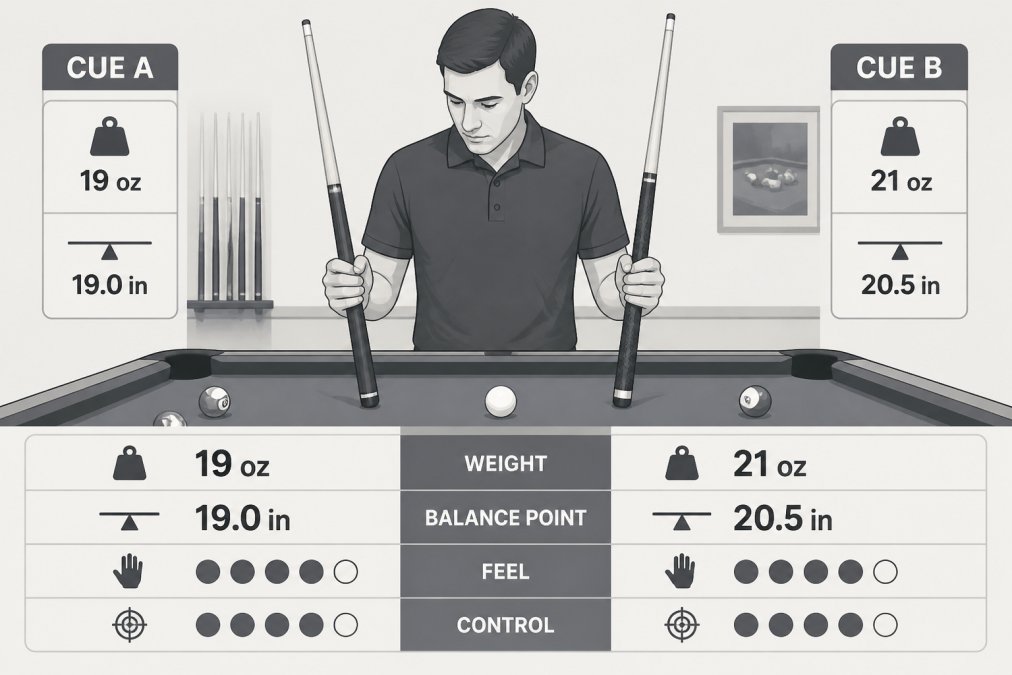
Compare your notes. After testing all three weights, review what you wrote. Look for patterns. Which weight gave you the most consistent results? Which one let you play longer without fatigue? Which felt most natural?
Make your choice. Your ideal weight is the one that lets you play your best game with the least effort.
Many serious players own multiple cues in different weights. They use a lighter cue (18 ounces) for regular play and a heavier cue (20 ounces) for breaking. This approach gives you flexibility and lets you optimize for different situations.
At sibilliards, we recommend starting with a quality cue in your chosen weight, then adding a second cue if you want to specialize.
Finding your ideal pool cue weight is a personal decision that depends on your strength, stroke style, and how you like to play. The 19-ounce standard works for most players, but your best choice might be different.
Frequently Asked Questions
What is the most popular weight for a pool cue?
19 ounces is the most common pool cue weight and serves as an industry standard starting point. It balances power, control, and maneuverability for most playing styles. However, the best weight for you depends on your personal preference, stroke strength, and the type of shots you play most. Many experienced players test weights between 17 and 21 ounces before settling on their ideal cue weight.
Should beginners use a lighter or heavier pool cue?
Beginners typically benefit from a lighter cue (17-18 ounces) because it's easier to control and allows for better stroke development. As your technique improves and your stroke becomes more stable, you can gradually test heavier weights (19-20 ounces) if you want more shot power.
What is the difference between a 19 oz and a 20 oz pool cue?
A 20-ounce cue delivers more shot power and generates faster cue ball speed compared to a 19-ounce cue. However, the heavier weight requires slightly more effort to control, may feel less maneuverable on tight shots, and can cause greater fatigue during extended play. The 1-ounce difference is subtle but noticeable to experienced players. Most players choose between these weights based on whether they prioritize power or touch in their game.
Can you change the weight of a pool cue?
Yes, many modern cues feature interchangeable weight systems that allow you to adjust the cue weight. Products like the Viking Valhalla series offer adjustable weight bolts, letting you modify your cue's weight without purchasing a new one. This feature is valuable for testing different weights and adapting your cue as your playing style evolves. Check your cue's specifications to confirm it has an adjustable weight system before attempting modifications.


