


Table of Contents
- Cuetec Cynergy vs Predator Revo: The Short Answer
- Low Deflection Pool Cue Shafts Comparison: How These Two Stack Up
- Cuetec Cynergy vs Predator Revo Price: What You Pay for Each
- Predator Revo Shaft Compatibility: Joints, Pins, and Fit
- Durability, Maintenance, and Long-Term Ownership
- How to Identify Authentic Predator Cues and Revo Shafts
- Which Shaft Fits Your Playing Style?
- Conclusion
- Frequently Asked Questions
Last Updated: October 18, 2026
Cuetec Cynergy vs Predator Revo: The Short Answer
The Cuetec Cynergy vs Predator Revo decision comes down to feel versus force. The Cynergy is a carbon fiber shaft option at $449, with a 15K carbon fiber build and a poly-foam core designed with Shane Van Boening. The Revo is a firmer, stiffer option at $549.

At sibilliards, we sell both as an authorized retailer, so we have no reason to push one over the other.
Below, we break down deflection, feel, price, joint compatibility, and durability so you can match the shaft to your stroke.
Low Deflection Pool Cue Shafts Comparison: How These Two Stack Up
A low-deflection shaft reduces squirt, the sideways push the cue ball takes when you strike it off center. Both shafts are carbon fiber composite and ferrule-less or near-ferrule-less by design. The difference is how they deliver the correction, and how you can verify it.
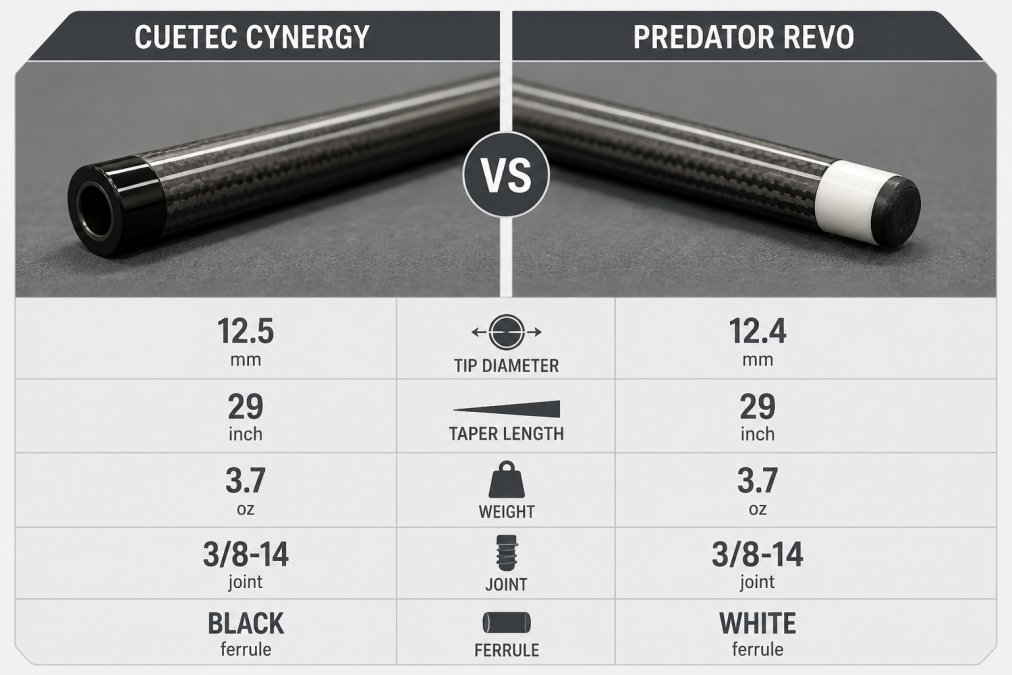
The Cynergy uses spun 15K carbon fiber tow over a poly-foam core, which is why it feels softer than most carbon shafts.
Neither shaft is "wrong" on deflection. They simply ask different things of your aim.
A Repeatable Test Protocol You Can Run Yourself
Most comparisons of these two shafts are broad impressions. This protocol turns "feels low-deflection" into something you can measure with a tripod and a chalk line.
- Match the variables. Use the same butt, tip hardness, cue ball, and cloth. Tip hardness changes perceived squirt more than shaft brand does.
- Set a fixed aim line. Place a chalk line or a laser down the center of the table. Set the cue ball on the line and a target ball 3 feet away, also on the line.
- Strike at fixed offsets. Apply one tip of English at three offsets: half-tip, one tip, and two tips. Repeat at three speeds: soft (lag speed), medium (center-table draw speed), and firm (break-speed follow).
- Measure the drift. Mark where the cue ball contacts the far cushion relative to the aim line. Repeat five times per condition and average the drift.
- Swap shafts and repeat. Keep the same butt, tip, and cue ball. The only variable that should change is the shaft.
Cue-Ball Deflection and Squirt
Squirt is the cue ball's tendency to drift off the aim line when you apply side spin. A low-deflection shaft narrows that gap, so you use English with less compensation.
The Revo 12.9 is the stiffer of the two, with low front-end mass. The Cynergy features a straight, elongated taper and an ultra-thin white sighting ferrule. Both are designed to reduce deflection compared to maple shafts.
If you want a number rather than a feeling, run the protocol above and write your averages down. A shaft that drifts 1 inch at two tips of English is a different tool than one that drifts 2 inches, and it shows up in your safety game long before your run-outs.
Feel, Feedback, and Hit
Feel is where these two shafts part company most clearly. The Cynergy was designed with Shane Van Boening, featuring a poly-foam core and Tiger Sniper soft tip.
The Revo 12.9 is described by Predator as the stiffest-feeling carbon shaft in the REVO line, with a firm hit and a ferrule-less front end.
To separate feel from deflection, hit the same center-ball stop shot with each shaft and listen. The Cynergy's softer core and Sniper tip produce a lower, rounder report; the Revo's sealed Vault Plate front end produces a sharper, higher-pitched click.
Cuetec Cynergy vs Predator Revo Price: What You Pay for Each
Price is the easiest part of this comparison. The Cuetec Cynergy 12.5mm and 11.8mm shafts both list at $449. The Predator Revo 12.9mm, in either the 5/16 x 18 black Vault Plate or 3/8 x 10 white Vault Plate version, lists at $549, as does the Revo 12.4mm Uni-Loc.

That $100 gap buys Predator's Vault Plate construction and the firmer REVO hit.
| Shaft | Diameter Options | Joint | Tip | Price |
|---|---|---|---|---|
| Cuetec Cynergy | 12.5mm, 11.8mm | Uni-Loc | Tiger Sniper soft | $449 |
| Predator Revo 12.9 | 12.9mm | 5/16 x 18, 3/8 x 10 | Predator Victory soft | $549 |
| Predator Revo 12.4 | 12.4mm | Uni-Loc | Predator Victory soft | $549 |
One note on diameter: the Cynergy's 11.8mm option offers a finer tip, while the Revo's 12.9mm is the widest in its line.
Predator Revo Shaft Compatibility: Joints, Pins, and Fit
Predator Revo shaft compatibility sinks more purchases than any other question. A shaft only fits a butt with a matching joint pin, which is why Predator sells the Revo in several joint configurations.
The Revo 12.9mm comes in a 5/16 x 18 version with a black Vault Plate and a 3/8 x 10 version with a white Vault Plate; the 3/8 x 10 fits both standard and Modified pins, covering many custom cue makers. The Revo 12.4mm ships with a Uni-Loc joint. Check your butt's pin before you order, not after.
Predator Revo 12.9mm 5/16 X 18 Carbon Fiber Pool Shaft (Black Vault Plate) →

Cuetec Cynergy Joint Options
The Cynergy line is simpler. The 12.5mm and 11.8mm shafts both ship with a Uni-Loc joint, so they drop onto any Uni-Loc butt without an adapter. If your cue uses a different pin, the Cynergy is not the plug-and-play option the Revo's multi-joint lineup is.
Durability, Maintenance, and Long-Term Ownership
Carbon fiber's real advantage over wood is that it does not warp, ding, or absorb moisture the way maple does. Both shafts share that benefit and need little care beyond a wipe-down and a tip check. What most comparisons skip is the ownership math over three to five years of league play, here it is, itemized.
What Wears Out, and What Does Not
The Revo's Vault Plate front end is sealed and ferrule-less, removing the ferrule as a failure point. The Cynergy's ultra-thin sighting ferrule is similarly minimal, and its finish wipes clean of chalk. Neither needs oiling or conditioning: keep them out of a hot car, store them in a case, and they will outlast several maple shafts.
The wear items are the same on both: the tip, the joint-collar finish, and the surface where your bridge hand slides.
Itemized Ownership Cost (Dated October 2026)
Prices below are list prices in USD and reflect what an authorized dealer typically charges; confirm current pricing before purchase, since both brands adjust list prices periodically.
| Cost Item | Cuetec Cynergy | Predator Revo |
|---|---|---|
| Shaft list price | $449 | $549 |
| Replacement tip (installed, typical shop rate) | $25-$40 | $25-$40 |
| Tip changes per year (heavy league play) | 2-3 | 1-2 |
| Annual tip cost | $50-$120 | $25-$80 |
| Shaft cleaner / microfiber | $10-$20 | $10-$20 |
| Case (if not already owned) | $40-$150 | $40-$150 |
| 3-year tip + care estimate | $160-$380 | $85-$260 |
Warranty and Repairability
Both brands back their shafts with limited warranties against manufacturing defects, excluding normal wear, tip wear, and damage from misuse or accidents. Read the terms on the listing before you buy, the exclusions matter more than the coverage, since the most common failures (a broken tip, a dinged finish) usually are not covered.
Repairability is where carbon differs from maple. A maple shaft can be sanded, re-tapered, and refinished by most cue repair shops. A carbon shaft cannot be sanded without damaging the weave, so finish scuffs are cosmetic and permanent, and a cracked core means replacement rather than repair. That is the trade-off for warp resistance: you give up refinishing.
Long-Term Verdict
Treat both shafts as five-year-plus purchases and the ownership question is simple: the Revo costs more up front and slightly less per year in tips; the Cynergy costs less up front and slightly more per year in tips. Over five years the totals land closer than the $100 sticker gap suggests. The real differentiator is not cost, it is whether you want the softer, more communicative Cynergy hit or the firmer, more predictable Revo hit for those five years.
How to Identify Authentic Predator Cues and Revo Shafts
Counterfeit Predator shafts circulate online, and the Revo is a frequent target because of its price and reputation. Knowing how to identify authentic Predator cues and Revo shafts protects your money.
Start with the seller: an authorized dealer will state the authorization plainly, and you can ask for it. On the shaft, check the Vault Plate color and fit, the joint pin threading, and the finish quality. Genuine Revos have clean, even carbon weave and a precise front-end assembly; fakes often show rough edges, inconsistent logos, or a ferrule that should not be there.
Which Shaft Fits Your Playing Style?
Match the shaft to your stroke. Here are some considerations:
- Finesse players and draw-shot specialists: Cynergy 11.8mm. The finer tip and softer feedback reward touch and precise contact.
- All-around league players moving off maple: Cynergy 12.5mm. Familiar feel, low deflection, and $100 less.
- Power players who favor follow and firm center-ball hits: Revo 12.9mm. The stiffest REVO hit and the widest tip in the line.
- Players who want maximum control in a narrower Revo: Revo 12.4mm with Uni-Loc.
- Custom-butt owners: Check the pin first. The Revo 3/8 x 10 covers standard and Modified pins.
Conclusion
Choosing between these two shafts is a choice about how you want to feel the shot. The Cynergy offers carbon performance at $449; the Revo offers a firmer, stiffer hit and Predator's Vault Plate construction at $549.
At sibilliards, we carry both as an authorized retailer, along with the joint configurations and diameters that actually fit your butt. Browse our carbon fiber shaft collection, confirm your pin, and subscribe to our emails for restock alerts and buying guides before your next league season.
Frequently Asked Questions
Which has lower deflection, the Cuetec Cynergy or Predator Revo?
Both shafts are built to reduce cue-ball deflection, and the difference comes down to diameter and construction rather than one clear winner. The Predator Revo uses a ferrule-less Vault Plate front end and low front-end mass, while the Cuetec Cynergy pairs a 15K carbon fiber wrap with a poly-foam core. In practice, a thinner 11.8 mm Cynergy will squirt less than a 12.9 mm Revo, so match diameter first, then test both on the same table before deciding.
Can you use a Predator Revo shaft with a Cuetec cue?
Only if the joint threads match. Predator Revo shafts ship in several joint options, including 5/16 x 18, 3/8 x 10, and Uni-Loc, and they thread onto any butt with the same pin. A standard Cuetec butt with a Uni-Loc pin will accept a Uni-Loc Revo shaft, but a Cuetec with a proprietary pin will not. Check the pin on your butt before ordering, and confirm the collar diameter matches so the joint sits flush.
Does the Predator Revo feel different from the Cuetec Cynergy?
Yes, the gap is noticeable. The Revo 12.9 mm is Predator's stiffest carbon shaft, so the hit feels firm. The Cynergy was designed with Shane Van Boening, and the hit is softer.
Which carbon fiber shaft is better for beginners?
The Cuetec Cynergy is an option for beginners. Its softer feel provides feedback on off-center hits, and at $449 it costs $100 less than a $549 Predator Revo. A 12.5 mm Cynergy offers a balance between control and power. The Cynergy ships with a soft Tiger Sniper tip.
How can you tell if a Predator cue or Revo shaft is authentic?
Buy from an authorized Predator dealer and check the shaft itself. Genuine Revo shafts carry the Predator logo and the Vault Plate front-end construction covered by patent US9814963B2, and the finish is smooth with no seams at the ferrule. Ask for the factory seal and the original packaging. If a price sits far below the $549 list, or the seller cannot confirm dealer status, treat it as a red flag and walk away.


