


Last Updated: October 26, 2026
Quick Summary
Carbon fiber shaft deflection refers to how much a pool cue shaft bends or flexes when the cue ball is struck, particularly on off-center hits. The shaft compresses and rebounds, causing the cue ball to travel on a slightly different path than intended, a phenomenon called squirt.
- Deflection happens at the moment of impact, before the cue ball leaves the tip.
- Low-deflection carbon fiber shafts are designed to reduce deflection compared to standard maple shafts.
- Deflection severity depends on how far off-center the strike is, how firmly you hit, and the shaft's inherent stiffness.
- After 30-50 shots with a new shaft, you'll develop an intuitive sense of its deflection characteristics.
- Squirt and swerve are distinct phenomena; squirt is deflection at impact, while swerve is spin-induced curve across the table.
Table of Contents
- What Carbon Fiber Pool Shaft Deflection Actually Is
- How Off-Center Hits Create Cue-Ball Deflection
- Pool Cue Shaft Deflection: Low-Deflection vs Standard Designs
- Shaft Construction: Carbon Fiber vs Maple and the Role of End Mass
- Cue Ball Deflection and English: Separating Squirt from Swerve
- How to Test Cue Shaft Deflection and Measure Performance
- Carbon Fiber Pool Shaft Compatibility and Practical Aiming Adjustments
- Upgrading to a Low-Deflection Carbon Fiber Shaft
- Frequently Asked Questions
What Carbon Fiber Pool Shaft Deflection Actually Is
Carbon fiber shaft deflection refers to how much a pool cue shaft bends or flexes when the cue ball is struck, particularly on off-center hits. The shaft compresses and rebounds, causing the cue ball to travel on a slightly different path than your aim intended. This phenomenon is called squirt.
The key difference between shafts lies in how much they deflect under impact. A low-deflection carbon fiber shaft is designed to reduce deflection.
Deflection isn't the same as the cue ball's natural reaction to English (spin). Side spin makes the cue ball curve across the table, that's swerve, a separate phenomenon. Deflection happens at the moment of impact, before the cue ball even leaves the tip. Understanding this distinction changes how you approach shaft selection and shot execution.
How Off-Center Hits Create Cue-Ball Deflection
When you strike the cue ball dead center with a perfectly vertical cue, energy transfers directly through the ball's mass. But most pool shots involve some off-center contact, intentional English or slight aiming variations. The moment the tip makes contact away from center, the shaft experiences lateral force.
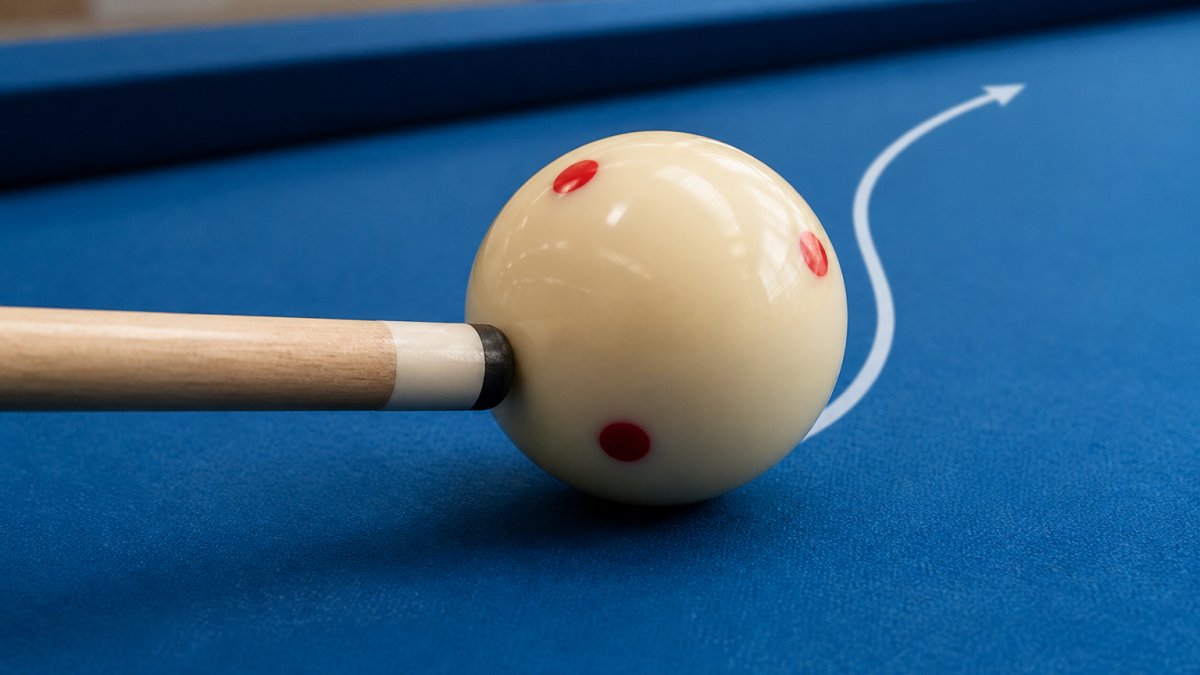
The shaft flexes sideways during impact, storing energy like a bent spring. As the tip rebounds, it pushes the cue ball slightly in the direction of the flex. On a low-deflection carbon fiber shaft, the rebound effect is reduced.
Deflection severity depends on three factors: how far off-center the strike is, how firmly you hit, and the shaft's inherent stiffness.
Pool Cue Shaft Deflection: Low-Deflection vs Standard Designs
| Shaft Type | Best For | Feel & Feedback |
|---|---|---|
| Standard Maple | Casual play, traditional feel | Warm, natural sound |
| Hybrid/Mid-Deflection | Intermediate players | Balanced feedback |
| Low-Deflection Carbon Fiber | Competitive, precision play | Solid hit, minimal flex |
| Extreme Low-Deflection Carbon Fiber | Tournament professionals | Firm, responsive feedback |
The Bull Carbon OG Shaft 12.65mm represents this balance, it's engineered to feel, sound, and play like maple while offering controlled low deflection. For players seeking extreme performance, the Bull Carbon RK series pushes deflection even lower with 100% pure carbon fiber construction.


Shaft Construction: Carbon Fiber vs Maple and the Role of End Mass
The Predator Revo 12.9mm Carbon Fiber Shaft has ferrule-less carbon fiber construction and a white Vault Plate.
Cue Ball Deflection and English: Separating Squirt from Swerve
Deflection (squirt) and swerve are distinct phenomena that happen at different points in the shot.
Squirt happens at the moment of impact. When you strike the cue ball off-center, the shaft flexes and rebounds, pushing the cue ball slightly off your aim line before it leaves the tip. This is deflection, pure and simple.
Bull Carbon OG Shaft 12.65mm Extreme Low Deflection Carbon Fiber Kamui →
How to Test Cue Shaft Deflection and Measure Performance
What matters more than precise measurement is your own feel and adaptation. After 30-50 shots with a new shaft, you'll develop an intuitive sense of its deflection characteristics. This is why many players recommend trying a shaft before buying, the real test is how it performs during actual play, not laboratory measurements.
Carbon Fiber Pool Shaft Compatibility and Practical Aiming Adjustments
Not all carbon fiber shafts fit all cue butts. Compatibility depends on the joint system, the connection mechanism between shaft and butt. The Bull Carbon OG and RK shafts use the V-TEK interchangeable joint system, with multiple joint options available depending on configuration. Check the product listing and select a joint option that fits your cue.
If you're unsure about compatibility, check your cue's documentation or contact the manufacturer.
Upgrading to a Low-Deflection Carbon Fiber Shaft
Choosing a pool cue shaft means considering its listed specifications and matching them to your equipment. You can explore high-performance carbon fiber play shafts designed for competitive play. At sibilliards, we offer carbon fiber shafts from Bull Carbon and Predator. Subscribe to our emails.
Frequently Asked Questions
What does deflection mean in a pool cue shaft?
Deflection is the amount the cue ball travels away from your intended line when you strike it off-center.
Do carbon fiber pool shafts have less deflection than maple shafts?
The Bull Carbon RK is listed as an extreme/ultra-low-deflection shaft. The Bull Carbon OG is listed as low/controlled deflection with a maple-style response.
How does cue ball deflection and English work together?
When you apply English by hitting the cue ball off-center, the shaft's deflection is one characteristic to consider. The Bull Carbon RK is listed as extreme/ultra-low deflection, while the Bull Carbon OG is listed as low/controlled deflection.
Can you put a carbon fiber shaft on any cue?
The Bull Carbon RK and OG shafts use the V-TEK interchangeable joint system, with multiple joint options available depending on configuration. Check the product listing and select a joint option that fits your cue.
What is the difference between shaft deflection and squirt?
The Bull Carbon RK is listed as extreme/ultra-low deflection, and the Bull Carbon OG is listed as low/controlled deflection.
How does shaft stiffness relate to cue ball deflection?
The Bull Carbon RK is made from 100% carbon fiber and is listed as extreme/ultra-low deflection. The Bull Carbon OG uses M30 carbon fiber with cross-lateral technology and is listed as low/controlled deflection with a maple-like feel.
How do I test my pool cue shaft for deflection?
The most practical test is the side-stroke accuracy test: shoot a series of controlled English shots at medium speed and measure how far the cue ball deviates from your intended line. Mark a target line on the table and count the deviation in inches over a set distance. A second method is the visual bend test: hold the shaft horizontally and apply downward pressure to see how much it flexes. For precise measurement, some players use deflection testing equipment or compare performance against a known low-deflection shaft. Consistent practice with the same shaft helps you adapt your aiming to its specific deflection characteristics.
Why do carbon fiber shafts cost more than maple shafts?
The listed prices are $549.00 for the Predator REVO and $467.99 for the Bull Carbon RK. The Predator REVO listing specifies a 29-inch shaft with a 12.9 mm tip diameter and a 5/16 x 14 joint. The Bull Carbon RK listing specifies 100% carbon fiber construction and a 10-year manufacturer warranty against warpage.


